As a practitioner in the field of information management and governance I have had to address a number of grave concerns in my chosen field. My path has taken me deep into many different pathways and one of them is the issue of the management and preservation of sacramental and religious records particularly records of the Christian Churches in Jamaica, Barbados and The United States. I do not claim to be the ultimate authority in the area but I believe my exposure to numerous church records in my capacity as an Archivist and Historian allows me to examine the topic with from a unique angle.
I will begin by making the observation that there is a crisis in the management of church records and archives that is quietly building and it is matter of time before the dam holding back the disasterous loss of records will break and an important aspect of collective memory held in one of the world’s foremost and long lasting instituitions may be lost forever if action is not taken.
My first serious encounter with the issue of the gathering storm began years ago in my attempt to find sources for my research paper ” Keeping The Dead Alive: Recordkeeping Practices In Jamaican Cemeteries” a topic countenanced by my erudite lecturer and mentor Stanley H. Griffin that explored the world of recordkeeping in Jamaican cemeteries. The unavoidable matter of church owned cemeteries (which for my non-Caribbean readers is a prevailing reality and inextricably linked) came up.
The search served as a means by which my understanding that Jamaican cemetery and by extension church records in Jamaica were still largely kept in the heads of the memory of aging church members and not sufficiently on paper or other record types. One church’s entire set of records dating back hundreds of years was totally lost in a fire and I had to rely on oral interviews of an aging, but still sharp church member to highlight aspects of the church and funerary practices of that denomination and fill in gaps with secondary and primary sources found elsewhere. Most recently the reality of the exposure of church records to serious disasters in the Caribbean was laid bare when Category 5 Hurricane Melissa struck Jamaica, Cuba and parts of Haiti. The Hurricane destroyed many churches, it is undeniable many of them will never recover and their precious records may be lost forever.

My experience in the churches United States while for the most part is better documented as a number of churches are deliberate about creating well organized church archives with professioanal archivists and collections much of which are donated to local and regional archives. I was most pleased to have worked with several important collections at the Vivian G Harsh Collection of African American History and Literature. In this repository, many highly valuable collections particularly those of African American Churches are held. I was pleasantly surprised to see the connections of theses churches with records connectng them to a several well known Caribbean based churches and religous organizations.
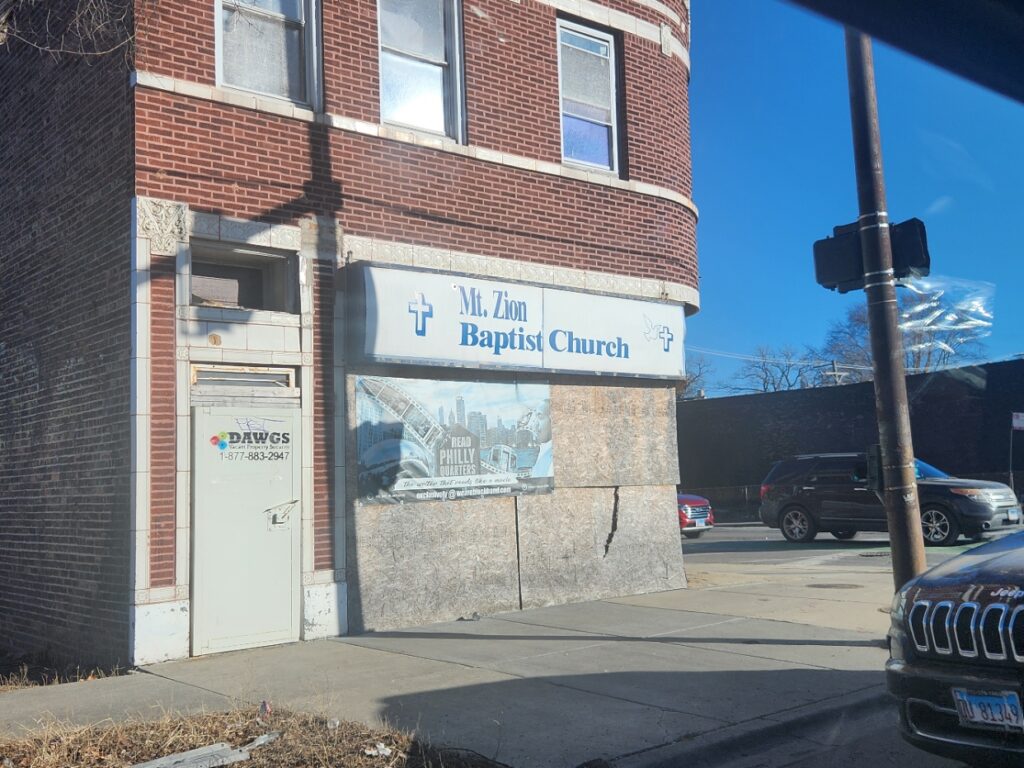
Photo of an abandoned church in Chicago there are many to be found in the South side of Chicago with no access to their records after closure or the passing of senior leadership for historical purposes. Photo Credit: Kimray Richards
I also interviewed a number of pastors and eminent archivists in the field and made some in person observations of records mangement practices which yielded results some of which are not too disimilar to those observed in Caribbean churches. The same issue where memory was completely reliant on the pastor or long term members or one church that embraced technology and software and in relatively good order to another where the entirety of the denomnation’s records were held in the pastor’s phone only. The issue of church records and congregations being time limited or time barred due to changing times and religious attitudes toward recordkeeping and rapidly declining membership also came up.
Here are ten top problems with church archives and records:
- Uncontrolled paper accumulation and cluttered storage (boxes everywhere, no system).
- Poor organization and labeling, making records hard to locate when needed.
- Loss or damage of vital records through neglect, water, pests, or casual disposal and natural disasters.
- Inaccurate or incomplete data in membership and sacramental records.
- No written records management policy or retention schedule.
- Overreliance on paper with no plan for managing digital records.
- Inadequate storage conditions (basements/attics, poor environment, insecure).
- No designated person or team responsible for archives and records.
- Privacy and confidentiality risks due to weak access controls.
- Lack of leadership awareness of the value of records, leading to underfunding and neglect.
Here is what to do to fix the issue.
Feel free to contact me for help, then follow the checkist below
- Name a Leader and Small Team
- Appoint a Records/Archives Coordinator (staff or trusted volunteer).
- Form a 2–3 person support team to help with sorting, labeling, and data entry.
- Ask the church board to affirm this role so it has clear authority and continuity.
- Do a Quick “What Do We Have?” Inventory
- Walk through offices, closets, basement/attic and list major groups of records
- Set Up a Simple Records Center
- Choose one reasonably dry, secure room or section of a room as the records area.
- Create Basic Order and Labels
- Group records by type: Sacramental, Membership, Minutes, Finance, Legal/Property, Publications, Photos.
- Protect the Most Important and Fragile Records
- Identify vital records: membership/sacramental books, legal documents, key minutes.
- Adopt a Basic Retention and Disposal Rule
- Start Managing Digital Records Intentionally
- Decide where official digital files live (shared drive, secure cloud folder—not personal laptops only).
- Address Privacy and Access
- Separate confidential records (pastoral care, personnel, discipline) from general records
- Privacy and confidentiality risksClassify records by sensitivity (public, internal, confidential, pastoral/disciplinary) and label storage accordingly.